Continue Reading Our Latest Articles
Written by our expert practitioners in Yoga, Ayurveda and Mindfulness, these articles will give you greater insight into the lifestyle practices and tools we teach for happiness and wellbeing.
In Yoga, the body is understood as a continuum of the mind, meaning that there is a loop of interaction between both.
Features that we would normally understand as belonging to the mind, such as emotions and thoughts, are in fact also experienced in the body; while experiences that are seen as physical in nature, such as pain, do actually affect patterns of thought and mental states. The boundaries between body and mind are understood as largely a convenient fiction.
With that in mind, using the body through postures and breathing practices is a powerful tool for changing and shaping our mental experience. These practices are an essential step in preparing the body and mind for deeper states of awareness, eventually leading toward meditation. The stability and ease of mind that we seek in meditation practice can initially be felt as a bodily experience, through the use and engagement of the limbs.
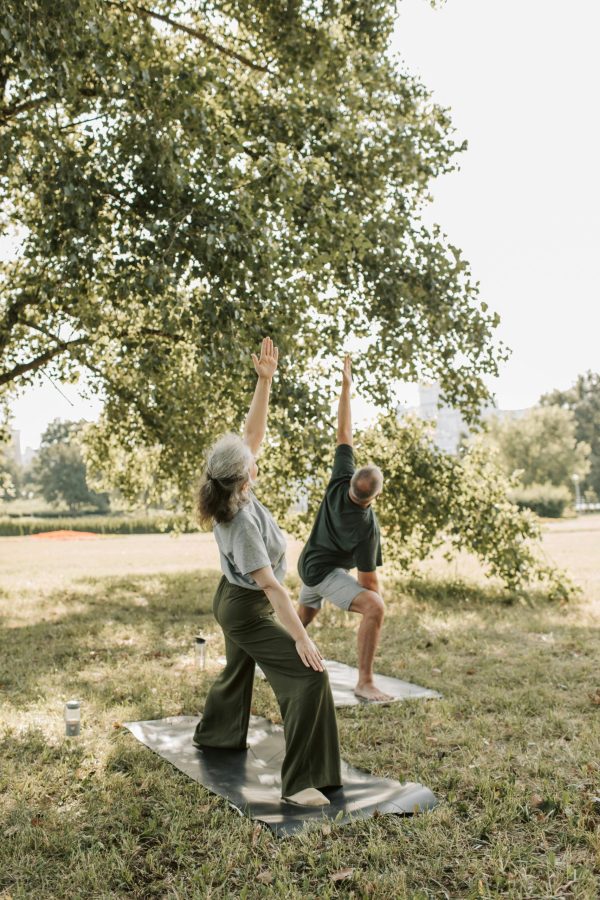
In simple terms, when the body is tense, weak, or restless, it becomes difficult to experience the stillness needed for meditation. Regular practice of Yoga postures (asanas) strengthens muscles, improves posture, and increases flexibility. Over time, the body becomes more balanced and relaxed, allowing practitioners to sit comfortably for longer periods. This physical ease removes one of the major obstacles to meditation.
Asana practice also helps regulate the breath and calm the nervous system when performed with attention and clear intention, particularly regarding breathing patterns. Many yoga postures are practiced with slow, mindful breathing.
This controlled breathing reduces stress and activates the body’s relaxation response. As the breath becomes steady and deep, the mind naturally begins to settle. This state of calm awareness is very similar to the mental state required for meditation.
Another important effect of asana practice is the development of mindfulness and concentration. When performing Yoga postures, practitioners are encouraged to focus on parts of the body, the breath, and sensations within the body. This focused attention trains the mind to remain present rather than wandering into the past or future. Over time, this ability to concentrate becomes stronger and can easily transition into meditation practice, where attention is directed inward toward the breath, a mantra, or pure awareness.
Furthermore, in Yoga, the body is understood as containing subtle energy pathways. Practising various postures helps balance and stimulate these energies. When energy flows more freely, practitioners may find it easier to sit quietly and experience deeper states of awareness. Although these energetic concepts are best understood within their own traditional context rather than directly equated with modern scientific terms, we might say that they relate to mental experiences that shape patterns and behaviours in the body. In this way, by interacting with the physical structure, we are also influencing the mental and emotional dimensions.
Therefore, in many ways, Yoga can assist a practitioner in enhancing their meditation practice.
Written by our expert practitioners in Yoga, Ayurveda and Mindfulness, these articles will give you greater insight into the lifestyle practices and tools we teach for happiness and wellbeing.